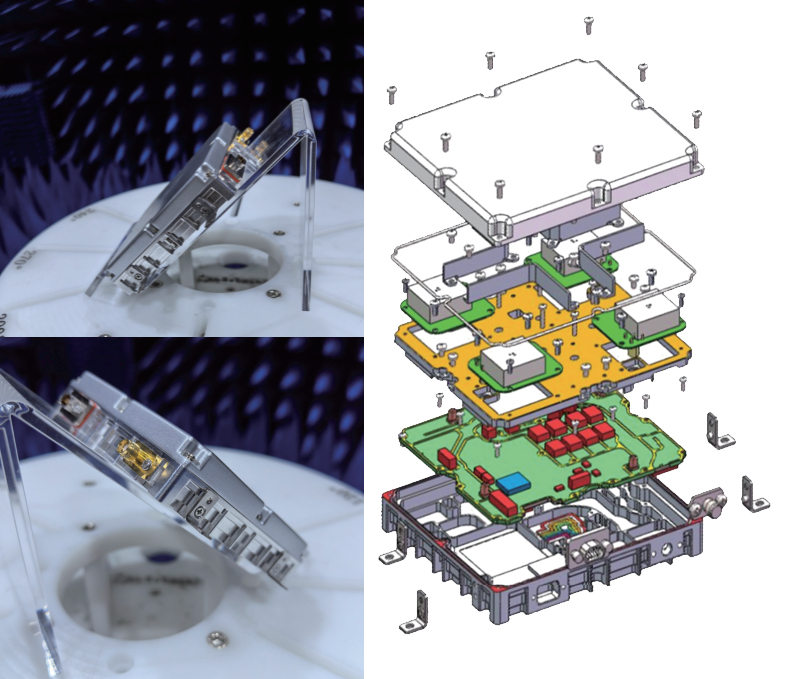
In today’s complex international environment, Global Navigation Satellite System (GNSS) signals face growing risks from intentional jamming, unintentional interference and even spoofing attacks. UAVs, autonomous systems and robotic platforms depend on GNSS as a primary source of positioning, navigation and timing (PNT). When that signal is compromised, missions can fail, assets can be lost, and safety can no longer be guaranteed.
To move from “best‑effort positioning” to ultra‑reliable navigation, using a standard GNSS antenna and hoping for a “quiet” RF environment is no longer enough. It has become essential to deploy powerful anti‑jamming and interference‑mitigation solutions at the GNSS receiver front end. This is exactly where advanced anti‑jamming antennas – especially multi‑element CRPA (Controlled Reception Pattern Antenna) solutions for GPS, BeiDou (BDS) and GLONASS – play a central role.
1. A New Reality: GNSS Under Severe Pressure
By the time GNSS signals reach the Earth’s surface, their power levels are extremely low. A small jammer, or even unintended RF interference, can easily raise the noise floor and drown out legitimate satellite signals.
Several trends make this problem more urgent than ever:
Regional conflicts and geopolitical tensions have led to deliberate GNSS jamming and spoofing in specific airspace and maritime corridors.
Rapid growth of UAVs and autonomous platforms means more systems are fully dependent on GNSS for navigation and mission execution.
Critical infrastructure – power, communications, finance, logistics – relies on GNSS for timing and positioning in ways that are often invisible but absolutely vital.
In this context, GNSS availability can no longer be taken for granted. Systems originally designed for open‑sky, benign environments now have to operate in contested RF conditions as part of their normal lifecycle.
2. What Makes An
ti‑Jamming Antennas Different?
A conventional GNSS antenna is essentially a passive listener: it receives everything in its band, amplifies it, and forwards it to the receiver. If there is strong interference, it will faithfully amplify that as well.
An anti‑jamming antenna – especially a multi‑element CRPA antenna – is fundamentally different:
It uses a multi‑element array layout instead of a single radiating element.
It controls the amplitude and phase of each element to form a dynamically adjustable reception pattern.
It can enhance useful signals from satellite directions while creating deep nulls towards jammers.
It works together with intelligent signal processing to detect, suppress and reject interference in real time.
In other words, an anti‑jamming antenna is no longer just metal and plastic. It is an active, adaptive RF front‑end that fundamentally reshapes how the GNSS receiver “sees” the RF world.
3. Synergy in Action: CRPA Antennas + GNSS Receivers
Advanced anti‑jamming CRPA antennas and GNSS receivers work together as a complete resilient navigation solution:
A multi‑element CRPA antenna collects signals across the sky.
An anti‑jamming processor (integrated in the antenna unit or in an external module) applies spatial filtering and null‑steering algorithms.
The cleaned‑up RF or baseband signal is delivered to the GNSS receiver.
The receiver performs acquisition, tracking, positioning and timing at much higher signal‑to‑interference ratios than would otherwise be possible.
This architecture enables the system to:
Detect abnormal interference coming from multiple directions.
Simultaneously suppress wideband, narrowband, sweep and pulse jamming.
Maintain stable tracking of genuine satellites even when the RF environment is far from ideal.
For UAVs, autonomous vehicles and robotic platforms, this is the real difference between “losing GNSS and aborting the mission” and “operating safely with graceful performance degradation”.
4. CHREDSUN: A Complete CRPA Anti‑Jamming Antenna Family
As a specialized provider of anti‑jamming antenna solutions, CHREDSUN offers a full portfolio of multi‑element CRPA GNSS antennas covering GPS, BeiDou and GLONASS. Our range is designed to address different platform sizes, performance levels and integration needs:
4‑element CRPA antennas
Compact, lightweight designs for small UAVs and space‑constrained platforms.
Provide fundamental anti‑jamming capability for B1/L1/E1 bands in highly integrated form factors.
8‑element and 16‑element CRPA antennas
Higher‑order arrays for industrial UAVs, tactical platforms and demanding applications.
Support BDS B1, GPS L1 and Galileo E1, with strong suppression against multiple jammers and improved spatial resolution.
230×230 mm class antennas supporting B1/L1/E1 + L2 or B1/L1/E1 + L5.
Provide dual‑band anti‑jamming and built‑in GNSS receiver options (PVT output) for high‑end aviation, defense and critical infrastructure systems.
These antennas are engineered to be easy to integrate with existing GNSS receivers and navigation systems, turning the concept of “interference mitigation” and “resilient PNT” into deployable hardware.
5. Compact CRPA Antennas for UAVs and Airborne Platforms
If your primary focus is UAVs and other airborne platforms, size, weight and power (SWaP) are always key constraints. CHREDSUN’s compact CRPA antennas are specifically designed for these use cases:
4‑element mini antennas
Ideal for small and medium UAVs that need basic anti‑jamming protection without significant SWaP penalty.
Provide multi‑constellation support (GPS/BDS/Galileo) and can suppress interference from 1–3 directions, significantly improving navigation robustness.
High‑performance 16‑element and 32‑element antennas
Target high‑end industrial and defense‑grade unmanned systems that must operate in harsh electromagnetic environments.
Support simultaneous suppression of many jammers, full 360° azimuth coverage and wide elevation ranges for comprehensive protection.
Across the range, CHREDSUN CRPA antennas share a common set of advantages:
Full 360° coverage with wide elevation angles, capable of addressing ground‑based, airborne and even elevated jamming sources.
Deep null‑forming capability, enabling simultaneous suppression of multiple interference sources from different directions.
Smart processing integration, with several models offering built‑in receivers that output either protected RF or full PVT solutions.
Integration‑friendly design, with standard RF and data interfaces (for example SMA, J30J, RS422/RS232), ensuring compatibility with existing receivers and flight‑control systems.
This makes it straightforward to upgrade a UAV or airborne platform from a vulnerable GNSS configuration to a resilient, anti‑jamming PNT architecture.
6. From “Optional” Upgrade to Strategic Necessity
From a business perspective, investing in anti‑jamming antennas can initially look like an additional cost. But once you consider the real economics, the picture is very different:
A single lost UAV or failed mission due to GNSS interference can cost far more than an anti‑jamming antenna.
For service providers, improved reliability builds customer trust and opens doors to higher‑value contracts in demanding environments.
For OEMs, offering “GNSS resilience” as a standard feature becomes a powerful differentiator in a highly competitive market.
As more users experience GNSS issues in real operations, customer expectations are shifting. They no longer ask only “What accuracy can you achieve?” – they also ask “How reliable is your system under interference?” Anti‑jamming antennas are a direct, credible answer to this question.
In this sense, GNSS anti‑jamming antennas are moving rapidly from a “nice‑to‑have option” to a strategic requirement for serious UAV and autonomous systems.
7. Conclusion: From Vulnerable GNSS to Resilient PNT
To summarize:
The global environment is making GNSS interference more frequent and more severe.
UAVs, autonomous systems, robotic platforms and critical infrastructure rely on GNSS in ways that cannot tolerate prolonged outages or spoofed signals.
Advanced multi‑element CRPA antennas for GPS, BeiDou and GLONASS, working in synergy with GNSS receivers, can detect, suppress and remove interference from multiple directions, even in the harshest RF environments.
By combining multi‑element CRPA antennas with intelligent signal processing, these solutions provide robust protection for navigation, guidance and control tasks across air, land and maritime domains.
For organizations that want to stay ahead, the key question is no longer “Do we really need anti‑jamming?”, but “Which anti‑jamming antenna best matches our platforms and missions?”
This is why, in today’s world, CHREDSUN anti‑jamming GNSS antennas are not just a technical upgrade – they are a strategic necessity for moving from vulnerable GNSS to truly resilient PNT.

 English
 العربية
 Français
 Русский
 Español
 Português
 Deutsch
 italiano
 日本語
日本語 한국어
한국어 Nederlands
 Tiếng Việt
 ไทย
ไทย Polski
 Türkçe
 አማርኛ
አማርኛ ພາສາລາວ
 ភាសាខ្មែរ
 Bahasa Melayu
 ဗမာစာ
ဗမာစာ தமிழ்
தமிழ் Filipino
 Bahasa Indonesia
 magyar
 Română
 Čeština
 Монгол
 қазақ
қазақ Српски
 हिन्दी
 فارسی
فارسی Kiswahili
 Slovenčina
 Slovenščina
 Norsk
Norsk Svenska
 українська
 Ελληνικά
 Suomi
Suomi Հայերեն
 עברית
עברית اردو
اردو Afrikaans
 Gaeilge
 नेपाली
 Aymara
 Беларуская мова
 guarani
 Krio we dɛn kɔl Krio
 Runasimi
 Wikang Tagalog